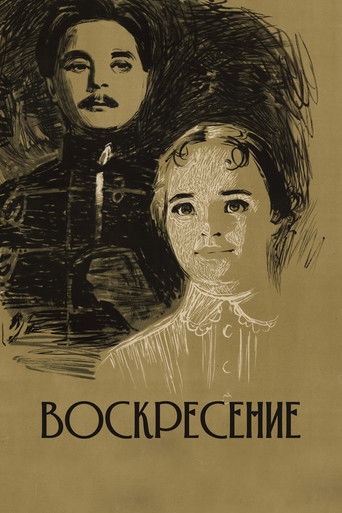
"Воскресение" (1960), produced by Mosfilm in the Soviet Union, is a poignant cinematic adaptation of Leo Tolstoy's classic novel "Resurrection." Directed by Mikhail Shveitser, the film masterfully captures the essence of Tolstoy's critique of the Russian judicial system and societal hypocrisy. The narrative follows Prince Dmitry Nekhlyudov, portrayed with depth and nuance by actor Evgeny Matveev, as he grapples with his conscience after serving on a jury that unjustly convicts a woman from his past, Katerina Maslova, played by the compelling Tamara Syomina. The film's black-and-white cinematography enhances its somber tone, reflecting the moral and emotional turmoil experienced by the characters. The adaptation remains faithful to Tolstoy's themes of redemption and social injustice, while also showcasing the director's ability to translate the novel's intricate character development onto the screen. Shveitser's direction emphasizes the stark contrast between the opulence of the aristocracy and the grim realities faced by the lower classes, a central motif in Tolstoy's work. The film's pacing allows for a thorough exploration of Nekhlyudov's transformation from a self-absorbed aristocrat to a man driven by a quest for justice and personal atonement. This journey is depicted with a realism that resonates with audiences, making "Воскресение" a timeless piece of Soviet cinema. One of the film's strengths lies in its ensemble cast, which brings to life the diverse array of characters that populate Tolstoy's world. From the corrupt officials to the downtrodden prisoners, each role is portrayed with authenticity and emotional depth. The performances of Matveev and Syomina, in particular, anchor the film, providing a compelling emotional core that drives the narrative forward. Their chemistry and the evolution of their relationship from past lovers to allies in the fight against injustice add layers of complexity to the story. "Воскресение" not only serves as a powerful adaptation of a literary masterpiece but also stands as a testament to the artistic capabilities of Soviet cinema during the 1960s. The film's enduring relevance lies in its unflinching examination of societal issues that remain pertinent today, such as the quest for justice and the potential for personal redemption. Through its compelling storytelling and strong performances, "Воскресение" continues to captivate and challenge audiences, cementing its place as a significant work in the canon of world cinema.
*If our moderation approves your version, it will be replaced and you will be credited as the text author.
Year1960
Runtime209 min
GenresRomanceDrama
Production countriesSoviet Union