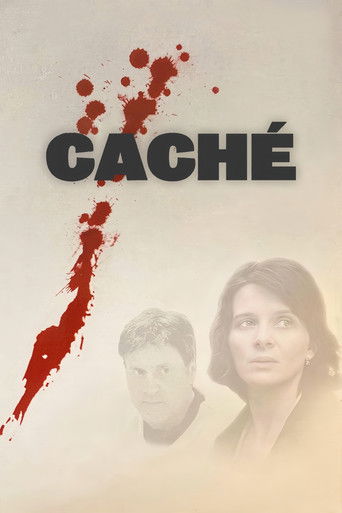
Hidden within.
"Caché" (2005), a gripping psychological thriller co-produced by Les Films du Losange and Wega Film, masterfully blends the suspense of a mystery with the depth of a social commentary. Directed by the acclaimed Michael Haneke, the film delves into the life of Georges Laurent, a successful television host portrayed by Daniel Auteuil, whose seemingly perfect life unravels when he begins receiving mysterious, disturbing videotapes. These tapes, which show surveillance footage of his home, plunge Georges and his wife Anne, played by Juliette Binoche, into a state of paranoia and fear. The film's setting in France adds a layer of cultural tension, as Georges's past secrets involving a childhood friend of Algerian descent come to light, forcing him to confront his guilt and the country's colonial history. Haneke's direction in "Caché" is both subtle and intense, using long, static shots to build an atmosphere of unease and to invite the audience to scrutinize every frame for clues. The film's narrative structure is deliberately paced, allowing the tension to simmer and the characters' psychological states to unravel gradually. The use of video tapes as a plot device is ingenious, blurring the lines between reality and surveillance, and prompting viewers to question the nature of truth and memory. The film's visual style, characterized by its muted colors and realistic portrayal of Parisian life, enhances the sense of authenticity and immersion. The performances in "Caché" are exceptional, with Daniel Auteuil delivering a nuanced portrayal of a man haunted by his past and struggling to maintain his façade of normalcy. Juliette Binoche complements Auteuil's performance with her own portrayal of a wife caught between loyalty and suspicion. The supporting cast, including Maurice Bénichou as Majid, the childhood friend whose life was irrevocably altered by Georges's actions, adds depth to the film's exploration of guilt, race, and class. The interactions between the characters are charged with tension, revealing the underlying currents of resentment and fear that drive the narrative forward. "Caché" is not just a thriller but a profound meditation on the impact of historical and personal guilt. The film's ending, which leaves many questions unanswered, is a testament to Haneke's trust in the audience's ability to engage with complex themes. By intertwining the personal with the political, "Caché" challenges viewers to reflect on their own complicity in societal injustices and the ways in which the past continues to shape the present. This masterful work by Les Films du Losange and Wega Film remains a haunting and thought-provoking piece of cinema that resonates long after the credits roll.
*If our moderation approves your version, it will be replaced and you will be credited as the text author.
Year2005
Homepage
Budget8500000$
Runtime118 min
Revenue16197824$
GenresMysteryDramaThriller
Production countriesFranceAustriaGermanyItaly